Fall is when most Lowcountry homeowners head out with the loppers and the rake to cut back overgrown foundation plantings before winter. This year there is one more reason to look closely. Clemson University is asking residents to check eaves, porch ceilings, shrubs, and hedges for nests of the yellow-legged hornet, an invasive species first found in South Carolina near Bluffton in 2023. If you come across a paper nest while you are working, leave it alone and report it through the yellow-legged hornet reporting tool; a response team will arrange removal.
That close walk along the front of the house tends to reveal something else. The shrubs that were knee-high when the house was built now reach the windowsills. The plants beside the front steps brush your shoulder on the way to the door. And you are trimming the same growth you trimmed last October. If you are fighting the same shrubs every fall, the problem is usually not the cleanup. It is the design. Here is how I tell when overgrown foundation plantings have run their course in Charleston and Mount Pleasant, and what replacing them looks like.
Why Do Foundation Plantings Become Overgrown?
Foundation plantings become overgrown because they are usually chosen and spaced for how they look on installation day, not for the size they reach in ten or fifteen years. Overplanting is the most common foundation planting mistake I see, and it almost always comes from wanting the beds to look finished right away.
The pattern is familiar across Mount Pleasant, Daniel Island, and the planned communities around Charleston. A new home gets a row of small shrubs, often from one-gallon containers, planted close together and close to the walls so the beds look full right away. For the first few years it works. Then the plants keep growing, because that is what they were bred to do.
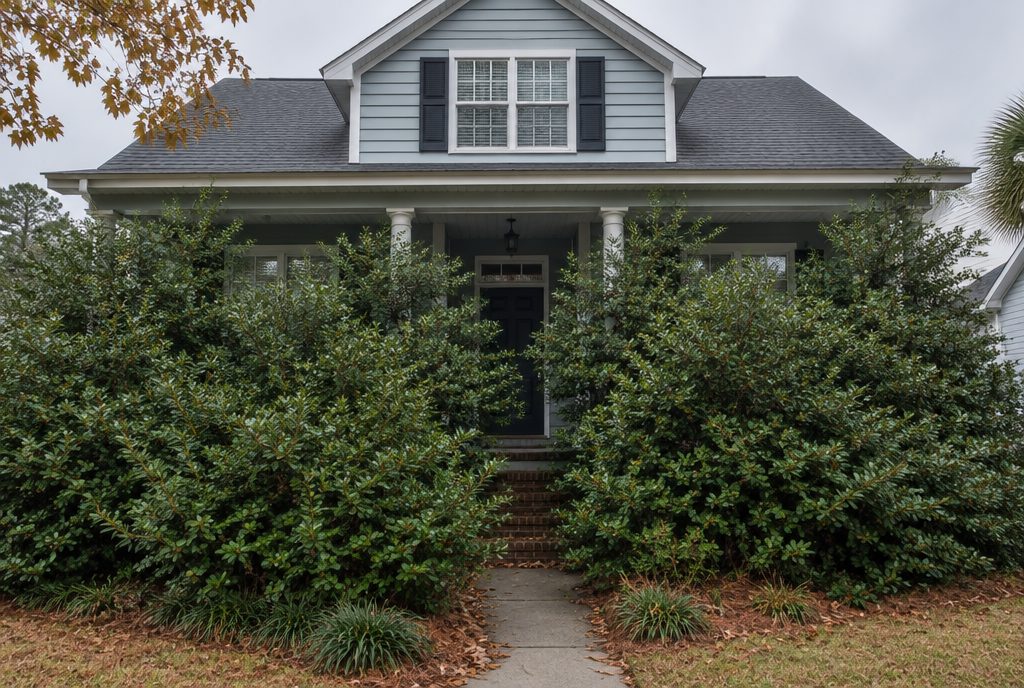
In 25 years of walking properties, first along the Southern California coast and now across the Lowcountry, I have found that many overgrown front beds trace back to the same decision: a shrub that looked right in the nursery pot, placed as if it would stay that size. No amount of cutting changes what a plant wants to become.
How Do You Know It Is Time to Replace Foundation Plantings?
It is time to replace foundation plantings when the shrubs have outgrown the space they were given, not just the shape they were trimmed to. These are the signs I look for on a front-of-house walkthrough.
Windows are disappearing. Tall shrubs do not belong under windows. If a shrub has to be cut below the sill every year to let light in, its mature height belongs somewhere else.
The shrubs are too close to the walls. Clemson Extension’s foundation planting guidance recommends that shrubs taller than six feet at maturity be placed so their foliage stays at least five feet from the walls, and that shorter shrubs have at least three feet of clearance. That space keeps air moving around foundation vents and helps prevent mildew, which matters in a climate as humid as ours.
The entry feels tight. An entry walk should be at least four and a half feet wide so two people can walk side by side, with nothing growing into the path or catching on clothing. If guests turn sideways to reach your front door, the planting is working against the house.
The shrubs are bare inside. Plants that have been sheared back hard for years often stay green only on the outer few inches, with woody, leafless growth underneath. Cutting further back exposes that, which is part of why the cycle is so hard to break.
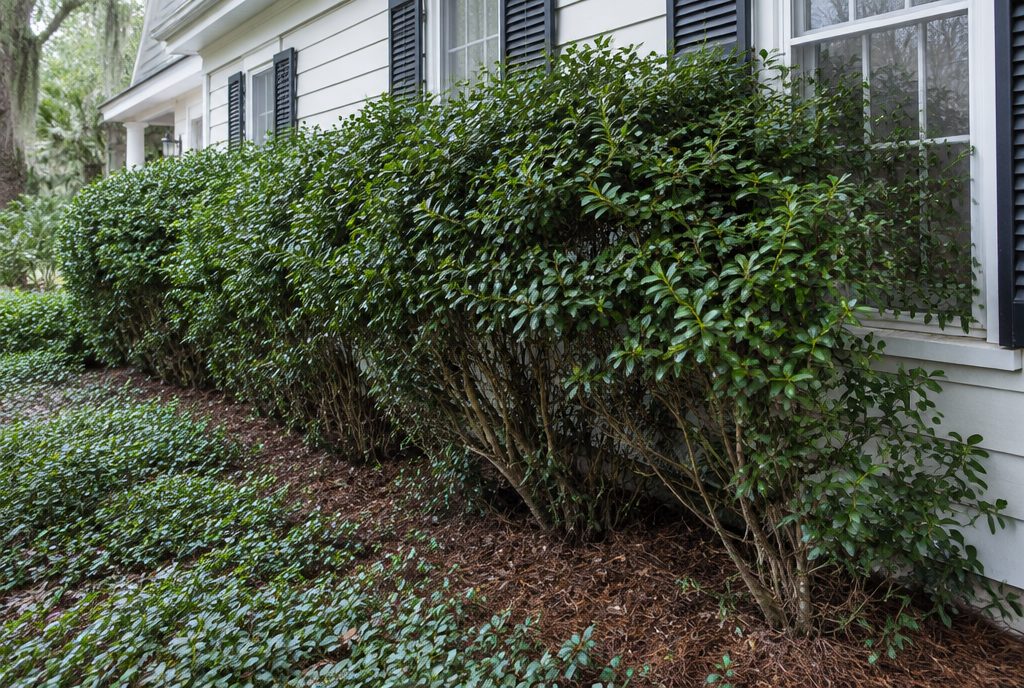
You can no longer see the house. Plantings at the front of a home should complement the architecture, not camouflage it. When the porch columns, the brick detailing, or the front steps are hidden behind a wall of green, the planting has stopped doing its job.
Should You Cut Back, Edit, or Replace Overgrown Shrubs?
The right answer depends on whether the plants still fit their space. Cutting back is only a lasting fix when a shrub’s mature size suits its location; a plant that has outgrown its spot will need more cutting each year, not less. Here is how the options compare.
| Approach | When it makes sense | What it solves | How long it lasts |
|---|---|---|---|
| Cut back again | The shrub’s mature size fits the space; it has simply grown out | Appearance for the season | Until the next growing season |
| Edit the bed | Some plants are well placed, while others crowd windows or the walk | Opens sightlines and the entry while keeping plants worth saving | Years, if the remaining plants fit their space |
| Replace in place | The bed layout works, but the plants are the wrong size | Right-sized plants at proper clearance from the walls | Long term, because plants are chosen for mature size |
| Redesign the entry garden | The beds, walk, and plantings all feel dated or cramped | The whole front of the house: entry, corners, walk, and lighting | Long term, with a plan built around the home’s architecture |
In my experience, most homes with ten- to fifteen-year-old foundation plantings fall into the middle two rows. There are usually a few plants worth keeping, such as a specimen tree at a corner or a mature camellia with real presence, and the rest are candidates for replacement.
What Does a Well-Designed Foundation Planting Look Like?
A well-designed foundation planting frames the house and leads the eye to the front door, rather than lining the walls with a continuous row of shrubs. I think of it in three parts: the entrance planting, the corner plantings, and a transition area that joins them.
The entrance planting sits nearest the door and should feel welcoming. I keep these plants low, both to avoid a hemmed-in feeling and to keep the entry open and visible, and I choose plants that look good year-round, since they are seen up close.
The corner plantings tie the house into the surrounding landscape. A small ornamental tree placed so it visually overlaps the corner of the house, without touching it at maturity, softens the architecture more than any row of shrubs can.
The transition planting between the entry and the corners should be simple and low. On Charleston homes with strong architecture, this is often where I plant less than homeowners expect: a groundcover or a low, even mass that lets the house itself carry the design.
Fewer, larger plants. Instead of a long row of small shrubs, I use fewer plants of more mature size. A few well-placed plants make a stronger impression than many small ones, and they are spaced for the size they will reach.
Built for Lowcountry humidity. In a climate this humid, foundation plantings should stay low and away from the house. I choose drought-tolerant plants for the area within five to ten feet of the foundation, avoid planting under the eaves, and keep groundcovers and mulch at least 12 inches off the foundation so they do not create a bridge for termites. A strip of gravel or crushed stone along the wall handles that last point cleanly and reads as a deliberate detail.
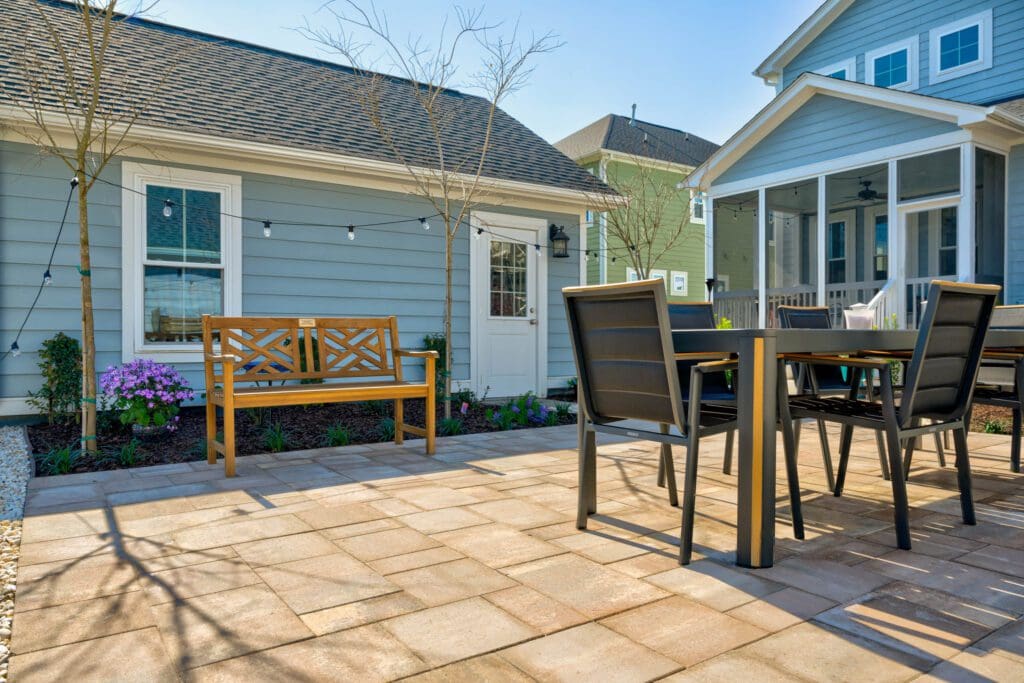
Raised homes need a different approach. On Sullivan’s Island, Isle of Palms, and other areas where homes sit well above grade, the planting has to soften a taller base and a longer run of stairs. The same principles apply at a larger scale: fewer, more substantial plants, sized to the height of the house, and clear, generous paths to the entry.

When Is the Best Time to Replace Foundation Plantings in Charleston?
Fall is the best time to replace foundation plantings in Charleston. The soil here does not freeze, so roots continue to grow through the winter while the tops of the plants rest, and new shrubs head into spring already established.
That timing lines up with the moment most homeowners notice the problem. The fall cleanup is when overgrown plantings are hardest to ignore, and it is also the start of the best planting window of the year. A design started in October can be installed while the weather is mild, and the new plants go into their first Lowcountry summer with a full winter of root growth behind them.
How a Foundation Planting Redesign Works With MP Landscape Design
A foundation planting redesign starts with a walkthrough of the front of the house: which plants are worth keeping, how the entry walk and steps function, where the sun falls, and how water drains away from the foundation. I spend as much time looking at the architecture as at the plants, because the planting should be designed around the house, not the other way around.
A $350 design retainer covers the on-site consultation and applies toward your design fee. The completed plan is delivered within five business days, with plant selections sized for mature growth, spacing and clearance from the walls, any hardscape or lighting changes at the entry, and a line-item budget. Our team handles removing the old plantings and installing the new design, so the plan is carried through exactly as drawn. You can read more about our landscape installation process and our approach to landscape design in Mount Pleasant.
We serve homeowners across Charleston, Mount Pleasant, Daniel Island, Isle of Palms, Sullivan’s Island, and Palmetto Bluff in Bluffton, SC.
FAQs About Overgrown Foundation Plantings in Charleston
How far from the house should foundation shrubs be planted? The general guideline is to place shrubs that grow taller than six feet so their foliage stays at least five feet from the walls, and to give shorter shrubs at least three feet of clearance. Groundcovers and mulch should stay at least 12 inches from the foundation. Always space plants for their mature size, not their size at planting.
Can overgrown shrubs be cut back hard instead of replaced? Sometimes, but it rarely solves the problem for long. If a shrub’s mature size is larger than the space it occupies, it will grow back into the same windows and walkways. Shrubs that have been sheared hard for years are also often bare inside. Replacing them with plants sized for the space is the lasting fix.
Can I keep some of my existing foundation plants? Yes. Most front beds have a few plants worth keeping, such as a well-placed corner tree or a mature shrub with good form. Part of the design process is identifying what to build around and what to replace. Keeping the best existing plants gives the new planting a more established look from the start.
When is the best time to replace foundation plantings in South Carolina? Fall. Because Lowcountry soil does not freeze, roots keep growing through the mild winter while the tops rest. New plantings installed in October or November go into their first summer with established roots.
Do I need a full front yard redesign or just new shrubs? If the bed shapes, entry walk, and overall layout still work, replacing the plants may be enough. If the walk is too narrow, the beds do not relate to the entry, or the front of the house feels cramped, a full entry garden redesign will give a better result. An on-site consultation is the quickest way to tell the difference.
Ready to See the Front of Your Home Again?
If the front of your house has disappeared behind shrubs that need cutting back every fall, I would welcome the conversation about what a right-sized design could look like. Fill out the design questionnaire and we will respond within 24 hours to set up a call.
Schedule Your Landscape Planning Call
To see completed work, browse the project portfolio, or read how I evaluate a full backyard redesign if the same questions apply out back.