Barrier island properties present a specific set of challenges for landscape lighting that most lighting contractors and generalist designers are not set up to solve well. Salt air corrodes the wrong fixtures within a season. HOA and municipal guidelines on Sullivan’s Island and Isle of Palms limit what can be installed and how bright it can be. And the natural setting on these islands, the maritime forest, the dune edges, the wide-open night sky, calls for a restraint in lighting design that suburban projects rarely require. Here is what I have learned designing and installing landscape lighting on both islands.
Why Coastal Landscape Lighting Is Different
The single biggest mistake I see on barrier island lighting projects is fixture selection that ignores the environment. A brass or bronze fixture that performs beautifully in Mount Pleasant or Daniel Island will pit, corrode, and fail within two to three seasons when it is sitting two blocks from the Atlantic. The salt air here is not a minor consideration. It is the primary one.
Fixtures specified for coastal installations need to be rated for marine-grade exposure. That means solid brass or marine-grade stainless steel construction, powder-coated or anodized finishes, and sealed housing that keeps moisture out of the socket and wiring. The added cost over standard fixtures is real, but it is far less than replacing an entire lighting system after a couple of summers.
Beyond the hardware, there is the question of placement and positioning. Wind on the islands is not the same as wind on a mainland property. Fixtures mounted on thin stakes in sandy soil can shift, tilt, and work loose over time. Anchoring methods and conduit depth matter more here than they do on most residential projects.
HOA and Municipal Lighting Guidelines on Sullivan’s Island and Isle of Palms
Both Sullivan’s Island and Isle of Palms have guidelines that govern outdoor lighting, and they are worth understanding before a design takes shape rather than after.
Sullivan’s Island in particular has restrictions oriented around sea turtle nesting season, which runs from May through October along the South Carolina coast. The South Carolina Department of Natural Resources designates the entire coastline as sea turtle habitat, and its guidelines call for lights that are not visible from the beach, directed downward rather than outward, and amber or warm-toned rather than white or blue-spectrum. The SCDNR sea turtle lighting guidelines are the authoritative reference here, and I review them for every project that sits within proximity to the beach on either island.
Isle of Palms has its own set of lighting and construction regulations that govern setbacks and exterior improvements. HOA rules vary by neighborhood and subdivision. Because our team is contractor-led, we assess the applicable guidelines as part of the design process and build compliance into the plan from the start. You should not be finding out about a lighting restriction after the fixtures are in the ground.
What these guidelines add up to, practically speaking, is a design philosophy that suits the islands well regardless of regulation: light low, light warm, and light only what needs it.
What Good Landscape Lighting Looks Like on a Barrier Island Property
The instinct on a lot of lighting projects is to add more. More fixtures, more coverage, brighter output. On Sullivan’s Island and Isle of Palms, the better instinct is almost always the opposite.
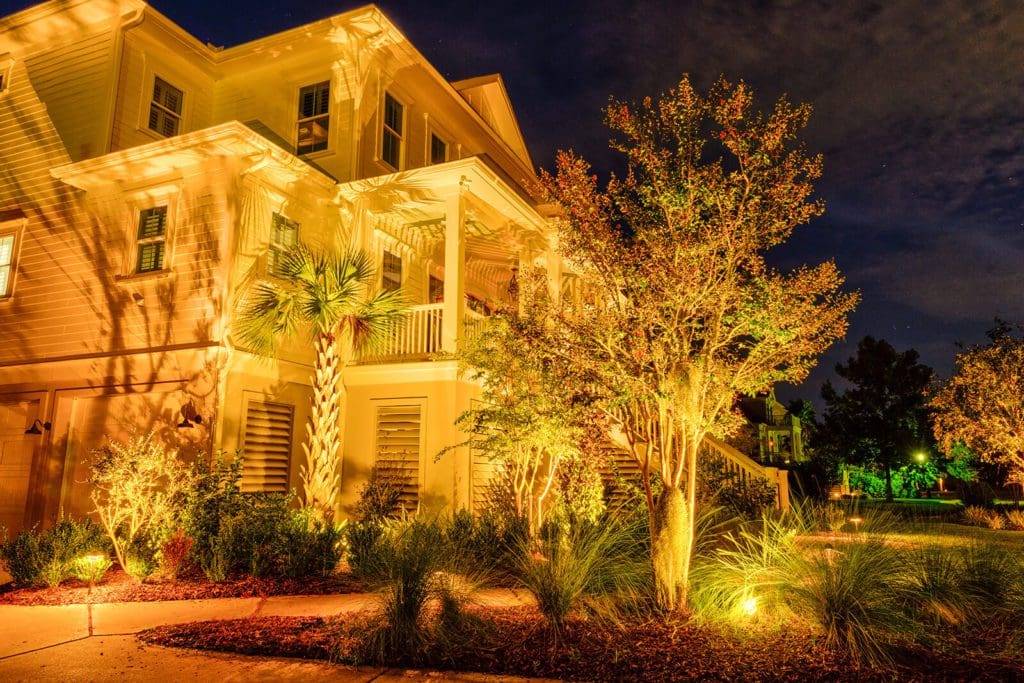
These properties have something most mainland yards do not: genuine darkness. The night sky on a clear evening on Sullivan’s Island is remarkable, and a lighting scheme that over-illuminates the yard competes with that rather than complementing it. The goal is to reveal the landscape after dark, not to flood it with light.
In practice, that means a few things:
Uplighting on significant trees. Both islands have mature live oaks and maritime forest canopy that uplight beautifully. A single well-placed fixture at the base of a large live oak does more for the appearance of a property at night than a dozen path lights scattered across the lawn. The key is aiming: the fixture needs to be positioned so the light grazes the trunk and lower canopy without spilling horizontally into neighboring properties or toward the beach.
Path and step lighting that guides without announcing itself. The best path lighting on a coastal property is barely visible as hardware during the day and provides exactly enough light to navigate safely at night. Recessed step lights and low-profile bollards in marine-grade finishes accomplish this well. Tall stake fixtures that put the lamp at eye level tend to create glare and draw more attention to themselves than to the path.
Patio and gathering space lighting designed for the evening, not the afternoon. Outdoor living spaces on these islands are used heavily in the summer, and the lighting needs to support that use without turning the patio into a parking lot. Warm-toned string or festoon lighting overhead, combined with a few low-level accent fixtures at the perimeter, creates an atmosphere that works for dinner parties and quiet evenings alike.
What I leave dark. On a coastal property, not everything needs to be lit. Open lawn areas, dune buffers, and areas close to the beach or marsh edge should stay dark. This is both environmentally responsible and aesthetically right. The restraint is part of the design.
Fixture and Bulb Choices for the Lowcountry Coast
For any coastal installation, I specify fixtures in solid brass or marine-grade 316 stainless steel. Both hold up in salt air where aluminum and standard steel do not. Finish matters too: a lacquered brass weathers to a natural patina that suits the coastal setting, while a powder-coated finish can chip and allow corrosion to start underneath if the coating is not marine-grade.
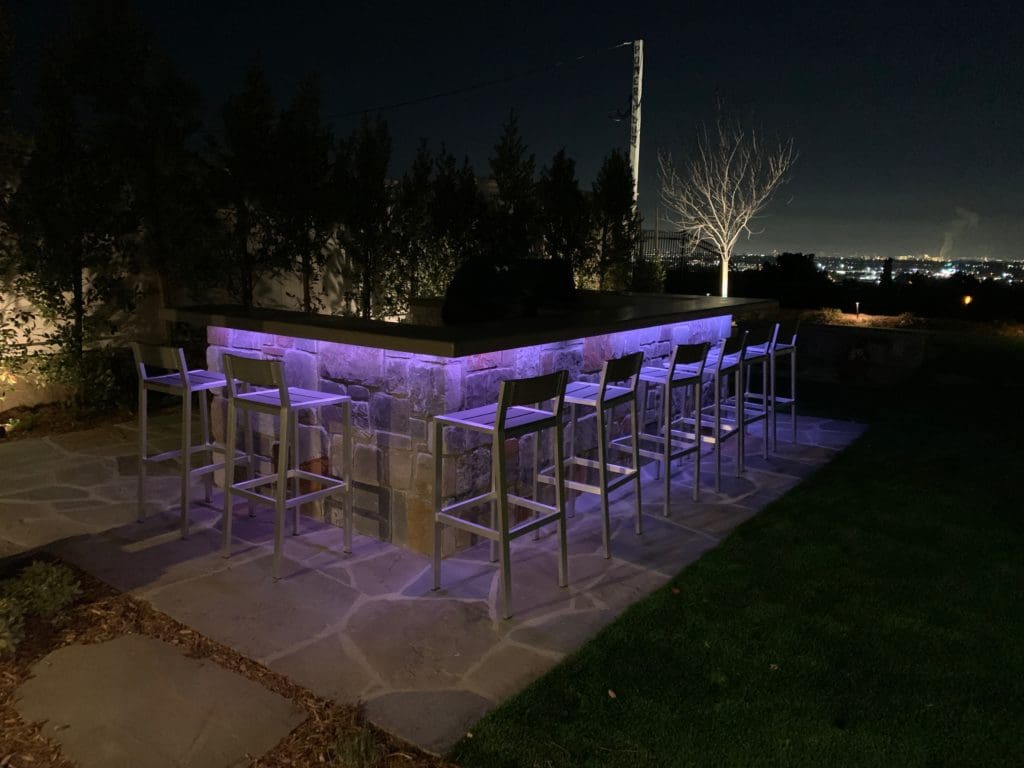
For bulbs, LED is the right choice on every coastal project for several reasons. LED fixtures run cooler than halogen, which reduces condensation inside the housing. They draw significantly less power, which matters when a lighting system is on a timer running several hours each night. And they last far longer, which reduces the frequency of trips up a ladder on a barrier island property, particularly for homeowners who use the property seasonally.
Color temperature is a meaningful design decision, not just a technical spec. Warm white, in the 2700K to 3000K range, is the right choice for most residential applications on the islands. It reads as natural and inviting rather than clinical, and it sits within the amber-toned range that sea turtle guidelines recommend for coastal properties.
Smart Controls and Seasonal Homeowners
A significant number of homeowners on Sullivan’s Island and Isle of Palms use their properties seasonally or split time between the islands and another residence. A well-designed lighting system with smart controls makes that practical.
Timer and sensor-based controls mean the exterior lighting operates on a schedule without anyone having to manage it manually. Motion sensors on entry paths and key areas provide security when the property is unoccupied. And smart system integration, where the lighting connects to a home automation platform, allows the homeowner to monitor and adjust the system remotely.
For properties that sit empty for weeks at a time, a lighting system that makes the home look occupied and the property look maintained is a practical security investment as much as an aesthetic one.
MP Landscape Design Serves Sullivan’s Island, Isle of Palms, and Beyond
We design and install landscape lighting across Sullivan’s Island, Isle of Palms, Mount Pleasant, Daniel Island, and Charleston. We now also serve homeowners in Palmetto Bluff in Bluffton, SC, where many of the same coastal lighting principles apply along the May River and tidal corridors.
Every lighting design is integrated into the overall landscape plan from the beginning, not added as an afterthought once the hardscaping is finished. The fixtures, placement, and controls are all part of a single coordinated design, which is how you avoid the patchwork look that comes from lighting decisions made separately from everything else.
FAQs About Landscape Lighting on Sullivan’s Island and Isle of Palms
What type of landscape lighting fixtures hold up best in the salt air on Sullivan’s Island and Isle of Palms? Solid brass and marine-grade 316 stainless steel are the two materials that hold up reliably in coastal salt air. Standard aluminum and steel fixtures corrode quickly in this environment. Finish matters as well: powder-coated finishes need to be marine-grade to resist chipping and undercutting. Sealed housing is essential to keep moisture away from wiring and sockets.
Are there restrictions on landscape lighting near the beach on Sullivan’s Island? Yes. Sullivan’s Island falls within sea turtle nesting habitat designated by the South Carolina Department of Natural Resources. During nesting season, which runs from May through October, outdoor lighting visible from the beach is discouraged. Guidelines favor downward-directed, warm-toned or amber fixtures that do not spill horizontally toward the shoreline. Sullivan’s Island also has its own municipal ordinances governing exterior lighting. We review all applicable guidelines as part of our design process.
What color temperature is best for coastal landscape lighting? Warm white in the 2700K to 3000K range is the right choice for most residential applications on the barrier islands. It reads as natural and inviting, ages well visually as the property changes through seasons, and aligns with the amber-toned recommendations in coastal sea turtle guidelines.
Should I use smart controls for my landscape lighting on Isle of Palms? Smart controls are worth the investment, particularly for homeowners who use the property seasonally or split time between residences. Timer and sensor controls keep the system running on schedule without manual management. Smart system integration allows remote monitoring and adjustment from anywhere.
Does MP Landscape Design handle the permits and HOA approvals for lighting installations? Yes. Because our team is contractor-led, we assess applicable municipal and HOA guidelines as part of the design process and handle the necessary documentation. Permit requirements vary by scope and municipality. We build compliance into the design from the start rather than treating it as a separate step.
Ready to Design a Lighting System That Fits Your Coastal Property?
If you are considering landscape lighting on Sullivan’s Island, Isle of Palms, or anywhere across the Charleston and Mount Pleasant area, I would welcome the conversation. Fill out the design questionnaire and we will be in touch within 24 hours.
Schedule Your Landscape Planning Call
You can also learn more about our approach on the landscape lighting service page or browse completed projects in the portfolio.